Sunday, July 22, 2007

Walking The Cat Back

Don’t Jump To Conclusion, even if the cat is radioactive

Polonium 210, the extremely rare radioactive isotope that proved fatal to Alexander Litvinenko on November 23, 2006, can be traced back to a meeting that took place at 140 Osier Crescent on Muswell Hill in London in the summer of 2006. That townhouse, valued at over one-million dollars, was owned, along with other town houses on the street, by the billionaire Russian exile Boris Berezovsky. At that meeting were two former KGB officers: Alexander "Sasha" Litvinenko, and Andrei Lugovoi. Litvinenko, who defected from Russia in November 2000, worked as a political advisor to Berezovsky (although Berezovsky was not present that night). Lugovoi had a successful business in Moscow distributing beverages and providing security services. What both men had in common is that they both had worked to protect Berezovsky in Russia when he was at the zenith of his power in the late 1990s and they had both been jailed for services they had done for Berezovsky after he fell from power (See Who’s Who In the Polonium Game). With its off-street parking , the townhouse provided them a secluded venue. Their business, according to Lugovoi, was setting up a "joint venture" between London and Moscow. The idea was that Litvinenko would supply British clients and financial backing and Lugovoi, who still had connections with Russian ex-KGB officers, who had formed a security service in Moscow called the Ninth Wave, would provide the services to help these British businessmen operate in Russia. After the meeting at Osier Crescent. Litvinenko gave Lugovoi a batch of items, including documents, to take back to Moscow that subsequently tested positive for Polonium 210, according to Lugovoi. (Since Polonium 210 has a brief half-life, 138.4 days, before half of it decays to non-radioactive elements, this dating can be verified by spectrographic analysis .) If so, the first appearance of the smuggled Polonium 210 was in the Summer, many months before Litvinenko died. The townhouse itself was so thoroughly contaminated by Polonium 210 that it was still uninhabitable– and unsalable– in the summer of 2007.
The reason that the Polonium 210 was not detected at Osier Crescent at the time, or even after Litvinenko was hospitalized in November, is that Polonium 210 is rarely found outside a nuclear lab. Indeed, its production is so tightly controlled by the International Atomic Energy Agency (IAEA) that when minute Polonium 210 traces were detected on equipment in Iran in the 1990s, it raised concerns that Iran was building a nuclear bomb since Polonium 210, in combination with Beryllium, can be used as the initiator for the chain reaction in a crude nuclear bomb. So IAEA inspectors, rushed to inspect Iran’s reactors but found no evidence that they had produced Polonium 210. The issue of whether the Polonium 210 had been smuggled inti Iran from Russian, Pakistan or other black market source or merely a residue on the equipment that Iran had imported was never resolved.
The London Polonium 210, however, set off no alarm bells. After that summer meeting, the next time its presence could be positively dated was October 16th, 2006. That day Lugovoi returned to London with his associate Dimitry Kovtun (See Who’s Who In The Polonium Game) and met at the offices of Erinys, a British consulting form, which Lugovoi suspected was a front for British intelligence. Litvinenko was present at that meeting as well as a number of British consultants who were interested in the "joint venture." Afterwards, the offices of Erinys tested positive for Polonium 210. So did the two rooms at the Parkes Hotel in Knightsbridge, where Lugovoi and Kovtun stayed on the night of October 16th. Lugovoi also visited the office of Berezovsky (supposedly to help arrange security for his relatives in Russia), and those offices later tested positive for Polonium 210.
Kovtun was certainly contaminated by October 28th 2006. That day he flew to Hamburg, where he had lived for 12 years, to renew his German residence permit. The permit was tainted with Polonium 210. So was the house he stayed in from the 28th to the 30th. These traces could be no more than sub-microscopic particles that attached themselves to dust or fibers.
On November 1st, Litvinenko visited four sites that later tested positive for Polonium 210. First, he went to the Itsu Sushi restaurant for lunch with Mario Scaramella (See Who’s Who In The Polonium Game), who had just flown to London from Italy. After that lunch, Scaramella was found to be contaminated by Polonium 210, and hospitalized . Next, at about 5 p.m., he went to the Pine Bar the Millennium Hotel to meet Lugovoi and Kovtun, who were also carriers. Not surprisingly, a dozen people in the Pine Bar showed traces of Polonium 210. Afterwards, he went to Berezovsky’s Mayfair office, where he used a fax machine, which also tested positive for Polonium 210. He then was driven home by the Chechen leader Akhmed Zakayev (See Who’s Who In The Polonium Game) whose car was tainted with Polonium 210.
Two days later, after cancelling a scheduled meeting with Lugovoi, Litvinenko was hospitalized with acute stomach pains. After he died on November 29th, the autopsy examination found that he had ingested Polonium 210 on two separate occasions, according to the London Telegraph. A tiny speck, as little as one millionth of a gram can be fatal if it is ingested. (The Coroner’s Report has not yet been released).
Meanwhile, Lugovoi and Kovtun, who were both hospitalized in Moscow, also tested positive as did their spouses.
So in the summer and fall of 2006 there was a stealth epidemic of Polonium 210 particles, a few which proved fatal to Litvinenko. But who contaminated who?
Table 1
The Stealth Polonium Epidemic
Contacts, Summer-Fall, 2006

Litvinenko Lugovoi Kovtun Scaramella Zakayev
Litvinenko - X X X X
Lugovoi X - X 0 0
Kovtun X X - o o
Scaramella X o o - o

Zakayev X o o 0 -

[To be Continued]

Monday, July 16, 2007

Who's Who At The Polonium Party


Berezovsky (cigar) and Zakayev, January 23,2006
Boris Berezovsky held his 60th black-tie birthday party at Blenheim Palace, Winston Churchill's birthplace. In the center of the room was an ice sculpture representing St. Basil's Cathedral on Red Square, coated with black caviar. At one table was Alexander Litvinenko, Andrei Lugovoi, and Akhmed Zakayev. They all had been born in the former Soviet Union and they had all been in prison. Ten months later, they all had another connection: Polonium-210.

The Polonium Players
In this deadly game, you need a program


Boris Berezovsky (a.k.a Platon Elenin)

Position: Financier and Revolutionary-in-exile
Polonium Link: Detected on his office furniture and fax machine.
Litvinenko Link: Employer
Dossier: Born in 1946, Berezovsky made an immense fortune in the 1990s in Russia. He acquired stakes in the national airline Aeroflot, the major automobile manufacturer, key oil companies and set up his own bank to transfer funds around the world. He also bought control of newspapers and television networks, including the powerful ORT channel. After Boris Yeltsen was re-elected in 1996 with Berezovsky's support, he appointed Berezovsky both deputy secretary of the National Security Council and Secretary of the Organization for Coordinating the Commonwealth of Independent States (CIS), which qualified him for protection by the Kremlin's Ninth Directorate of the FSB, the successor to the KGB. After Putin came to power in 2000, Berezovsky lost his political power base. He came under criminal investigation for diverting hundreds of millions of dollars from Aeroflot and faced indictment. He fled Russia to his villa in the French Riviera, he was arrested in there on a Russian warrant. After his release, he moved to Britain, which granted him political asylum. Among his political activities in London, he funded anti-Putin exiles, including Alexander Litvinenko. Berezovsky's stated goal was to overthrow the Putin regime, explaining in a 2007 interview with The Guardian,"It isn't possible to change this [Putin] regime through democratic means. There can be no change without force, pressure." Asked by the reporter if he was effectively fomenting a revolution, he said: "You are absolutely correct."
Status: Target of a Russian extradition warrant. On trial in absentia for fraud in Moscow

Alexander Litvinenko (a.k.a Alexander Volkov, a.k.a Chris Reid)


Position: KGB Defector, Author
Polonium Link: It killed him.
Berezovsky Link: Protector(Russia), Political advisor (UK)
Dossier: Born in 1962, Litvinenko spent most, if not all ,of his career in the intelligence game. In 1986, he served in KGB military counterintelligence. In the Chechen rebellion in the late 1980s, he recruited KGB sources in Chechnya. In 1991, the KGB was renamed the FSB, and he worked in its newly-created Department for the Analysis of Criminal Organizations . His duties included the surveillance and penetration of Russian organized crime. In 1998, he was put in charge of protecting Berezovsky. In 1999, after Litvinenko charged that the FSB planned to assassinate Berezovsky, Litvinenko was fired from the FSB and accused of stealing munitions. With any trial, he was imprisoned. In 2000, he was released on condition that he remain in Russia (and surrender his passport). He then fled to Turkey on a false passport under the alias "Chris Reid." From Turkey, he went to Chechnya . According to Russian officials, his mission in Chechnya in 2000 was "to eliminate evidence of Boris Berezovsky's involvement in funding illegal armed groups there." Berezovsky, for his part, denied illicit channeling money to separationists. Whatever the purpose of Litvinenko's work in Chechnya, he rejoined Berezovsky in London on November 1, 2000, where he received political asylum. With Berezovsky’s backing, he worked ceaselessly to discredit Putin as a sponsor of state terrorism. His book Blowing Up Russia alleged that Putin’s FSB, not Chechen separationists, had blown up six Russian apartment houses in 1999, and that the Chechens were framed for the death of some 300 residents in those buildings. He said that Putin's motive was to create the pretext for re-invading Chechnya. His book Gang From Lubyanka claimed that Putin was deeply involved in Russian organized crime. In interviews he alleged that the 2002 seizure of a Moscow theater by Chechen women was organized by "FSB agents among the Chechens" and accused Putin of personally ordering the assassination of journalist Anna Politkovskaya. He eveb alleged that Putin’s FSB had trained Bin laden’s partner in 9-11, Ayman al-Zawahiri, for half of a year in Dagestan in 1998. Litvinenko may also been involved with Berezovsky a less-public activities According to Vyacheslav Zharko, a Russian official who alleges that MI6 recruited him in 2003, Litvinenko and Berezovsky acted as access agents for MI-6. Under the pretext of a meeting with British businessmen, they introduced him to three MI6 officers– "John Callaghan," "Kenn Philips," and "Paul" –who then recruited him as a spy. Andrei Lugovoi, a former Russian security officer, tells a similar story, saying that Litvinenko brought him to meetings in October 2006 with British businessmen who openly attempted to recruit him as a spy for MI-6. If so, Litvinenko was acting as an access agent for MI6 about the time he came in contact with the Polonium 210.
After his death, Polonium 210 was detected in his home and on his clothes.
Status: Died November 23, 2006

Andrei Lugovoi


Position: security expert
Polonium Link: Polonium 210 was detected on him, as well as his wife, children and possessions.
Berezovsky Link: Protector in Moscow
Litvinenko Link: Prospective business partner
Dossier: Born in Azerbaijan in 1966, Lugovoi enrolled in the KGB at the age of 21. During the Yeltsen administration, when the KGB became the FSB, he worked at the Kremlin's personal security unit, where he met Berezovsky. In 1996, he left the FSB to head security at Berezovsky’s television fiefdom, ORT, . After Berezovsky fled Russia in 2000, Nikolai Glushkov, his top associate in Aeroflot war arrested and put under pressure to provide evidence against Berezovsky. Lugovoi had the task of breaking Glushkov out of prison but the escape went awry and Lugovoi served 14 months in prison. After he was released, he set up Pershin, which provided security services to multimillionaires and sold beverages. When he went to London for Berezovsky's gala birthday party on January 23, 2006, he was seated at the same table with Litvinenko, who he had known from the KGB and FSB. Several months later, according to Lugovoi, Litvinenko asked him to come to London to discuss a lucrative joint venture with British businessmen. In the summer he met Litvinenko at his home who gave him documents and "gifts" to bring back to Moscow. The material later tested positive for Polonium 210. indicating that Litvinko (and Lugovoi) were in contact with Polonium 210 four to six months before Litvinenko died. As the deal progressed, Lugovoi and his Moscow associate Dmitry Kovtun met Litvinenko at Erinys, a British security firm. During that meeting, the British participants, according to Lugovoi, tried to recruit him as source for information about the FSB, leading him and Kovtin to assume that they were MI6 officers . The offices of Erinys later tested positive for Polonium-210. Lugovoi last met Litvinenko on November 1st at the Pine Bar.
Status: Subject of a British extradition warrant


Dmitry Kovtun

Position: Consultant
Polonium Link: Detected in his body, in his hotel room, in his Hamburg residence.
Berezovsky Link: Business prospect.
Dossier: Born in 1966, Kovtun graduated from the elite Supreme Soviet Military Command School in 1985. He then served in military intelligence in Eastern Europe, posted in Prague and Berlin, in the final days of the Cold war . From 1991 until 2003, he lived in Hamburg, Germany, eventually marrying a German national, Marina Wall, and working as a "consultant". After 12 years in Germany, he returned to Moscow (without his wife) in 2003 and, continued a consulting career in "oil and gas." Lugovoi, who had known him since they were in school, suggested he come to London to participate in Litvinenko's "joint venture". Kovtun accompanied Lugovoi to the October 16 meeting at Erinys. On October 28, he flew to Hamburg to extend his residence permit The permit, his residence, and ex-wife later tested positive for Polonium 210, indicating that he was contaminated after the October 16th meeting. On November 1, he again saw Litvinenko at the Pine Bar.
Status: Subject of German investigation into Polonium smuggling.


Akhmed Zakayev


Position: Chechen leader. Foreign Affairs Minister of the Chechen Republic (exiled in London)
Polonium Link: Detected on front seat of his car
Berezovsky Link: Ally, attended his 60th Birthday party
Litvinenko Link: Appointed Litvinenko in 2002 to the Commission on " war crimes committed on the territory of Chechnya by the Russian occupying troops."
Dossier: Born April 1956 in Kazakhstan, Zakayev first achieved stardom as an actor at the Grozny theater. In 1990, after Chechnya seceded from Russia, he was appointed its Minister of Culture. After Russia re-invaded Chechnya, Zakayev first fought with the rebels and then went into exile in Denmark, where he was arrested on a Russian warrant. He then went to Britain, where he receive political asylum. He met Litvinenko in London in 2003, and kept, as he stated in his deposition, "in constant contact" with him. At 6 pm on November 1st, Zakayev picked up Litvinenko from Boris Berezovsky's Mayfair office, where Litvinenko had gone after his meeting at the Pine Bar, and drove him home.
Status: Subject of Russian extradition warrant

Mario Scaramella


Position: Security Consultant
Polonium Link: Contaminated, hospitalized
Litvinenko Link: Source on KGB penetration of Italy
Dossier: Born in 1970 in Naples, Scaramella went to work in 2002 as an advisor to Italy’s Mitrokhin Commission which was investigation allegations of KGB recruitment of Italian politicians. After Scaramella paid Litvinenko to provide information about KGB/FSB operations in 2005, he met again with him around lunchtime on November 1 at the Itsu Sushi. After that meeting (and before Litvinenko proceeded to his meeting with Lugovoi at the Pine Bar), Scaramella was contaminated by Polonium.
Status: In Prison on unrelated charge of calumny

[See Theories Below]

Saturday, June 30, 2007

The Litvinenko Mystery Thriller: A Primer of Conspiracy Theories

On November 23, 2006 Alexander Litvinenko, an ex-KGB officer exiled in London, died of Polonium-210 poisoning. The possible crime scenes, including the offices, restaurants, hotels , cars, and airplanes tainted by the rare radioactive isotope , were badly compromised by the three week delay in examining them. The Coroner's Report still has not been released, so there is no official cause of death. The lack of evidence has given rise to a rich proliferation of conspiracy theories that deserves a taxonomy.
THE FIRST QUESTION: HOW DID LITVINENKO DIE?
I. The Poisoned Sushi Theory


Proponent: Alexander Litvinenko


Thesis: Litvinenko had been poisoned by thallium, a rat poison, in the Itsu Sushi restaurant on November 1 while dining with Mario Scaramella.
Selling points:
*** Litvinenko had sharp stomach pains on November 1st after eating Sushi with Mario Scaramella
Drawbacks:
*** It was not Thallium but Polonium 210 that poisoned Litvinenko
*** Litvinenko’s Russian associates got contaminated before Litvinenko got to the Sushi restaurant.
Status: DOA

II. The Spiked Tea Theory


Proponent: Scotland Yard


Thesis: Tea served to Litvinenko at the Pine Bar of the Millennium Hotel on November 1st 2001 was spiked with Polonium 210 by his Russian associate Andrei Lugovoi.
Selling points:
*** Witnesses saw Litvinenko in the Pine Bar with his Russian associates
*** A hotel tea pot tested positive for Polonium 210
*** A November 1st bus ticket (found among Litvinenko’s effects) did not test positive for Polonium 210, suggesting Litvinenko had been Polonium-free shortly before going to the Pine Bar.
*** A waiter at the Pine Bar, Norberto Andrade, recalls being distracted by others at Litvinenko's table and this distraction might have provided the opportunity in the crowded bar to poison his tea.

Drawbacks:
*** Polonium 210 is not an efficient assassination weapon. Not only is it expensive, slow-acting, and difficult to obtain, but it is a tell-tale poison, traceable back to its source.
*** The tea pot was cycled through a dishwasher for weeks before the police tested it. It is therefore difficult to fit into a chain of evidence.
*** The absence of Polonium on a ticket does not really prove that Litvinenko was free of polonium contamination. It only suggests that it was not on the hand he used to handle the ticket.
*** The inability of a waiter to see what happened is only evidence that he is not a witness to what happened.
*** The autopsy showed that Litvinenko was exposed to Polonium 210 on more than one occasion, so there is no way to exclude the possibility that he contaminated the tea cup.
*** Litvinenko went to the Pine bar at 5 pm on November 1st after he had met Mario Scaramella at the Itsu Sushi for lunch. Scaramella was contaminated. So Litvinenko must have had the Polonium 210 on his person before he went to the Pine Bar.
Status: In abeyance awaiting a British extradition request that has been turned down.

III. The Serial Poisoner Theory

Proponents: autopsy doctors


Thesis: Litvinenko was poisoned twice, first in Mid-October, then again, at the Pine Bar on November 1st
Selling Point:
*** It explains why the post mortem examination shows two different times Litvinenko was exposed to Polonium 210.
Drawback:
*** Polonium can take many weeks, if not months, to kill someone. So how would a murderer know after only 2 weeks that the first dose was not effective ?
*** If Polonium 210 did not work the first time, why not use another poison (or a bullet) in the follow-up assassination attempt.
Status: Awaiting release of the Coroner's Report

IV. Accident Theory


Proponent: Vyacheslav Zharko
Thesis: Litvinenko had come in contact with smuggled Polonium 210 and a speck leaked onto his clothes, possessions or person, and it then fell into his food. According to Vyacheslav Zharko, a Russian official who Litvinenko allegedly helped recruit for British intelligence in 2002, Litvinenko "kept telling me that he needed money badly Possibly, that with the help of [Akhmed] Zakayev and his other Chechen 'friends' he could have got involved in smuggling of radioactive materials, and then - by accident or not - received a lethal dose."
Selling Points:
*** Historic context: All 5 previously known deaths from Polonium poisoning, including Irene Curie, were accidental. (See Follow the Polonium )
*** Litvinenko was in contact with Polonium 210 long before he entered the hospital in November. According to one of his associates in Moscow, material he received from Litvinenko in "the summer" of 2006 proved to be Polonium-tainted. (The date of the Polonium contamination can be determined by spectrographic analysis.) In any case, he was certainly in contact with Polonium 210 in Mid-October.
*** There was an accidental Polonium 210 leak in London in October. Over 100 people were accidentally contaminated by the Polonium 210 including 3 of Litvinenko’s associates. Just because Litvinenko ingested it and died does not mean he was not contaminated by the same accidental spillage that got on his associates.
Drawback:
*** It is not probable that spilled Polonium 210 would get into food or drink.
Retort: Isn't murder by Polonium 210 also improbable?

THE SECOND QUESTION: WHO (IF ANYONE) DID IT?
I. Vladimir Putin


Proponent: Marina Litvinenko ("J'Accuse" in Wall Street Journal).


Thesis: Putin personally ordered an agonizing death for Litvinenko.
Selling points:
***- Litvinenko accused Putin on his death bed
***- Putin had a motive for vengeance: Litvinenko accused Putin of being a pedophile
***- Putin had access to the Sarov facility, where Polonium 210 is manufactured.
Drawback:
***- The leak of Polonium 210 was not necessarily authorized by President Putin. The security of Russia’s nuclear facilities has been breached many times before. Even nuclear suitcase bombs, have been stolen out of them and smuggled into the black market.
II. KGB Veterans

Proponent: Mario Scaramella


Thesis: A shadowy group of KGB veterans called Dignity and Honor had a "hit-list" of people targeted for assassination which had been emailed to Scaramella.
Selling point:
*** At the Itsu Sushi restaurant Scaramella told Litvinenko that both he and Litvinenko were on the hit list .
Drawbacks:
*** Scaramella was never able to produce the putative list.
*** Litvinenko initially suspected Scaramella of being the poisoner.
*** Scaramella is currently in prison on charges of calumny
III. Rogue FSB Agents
Proponent: MI-6 British Intelligence


Thesis: A rogue unit of the FSB, the successor to the KGB, assassinated Litvinenko without higher authorization. According to the Guardian: "British officials say the perpetrators were probably former Russian security agents, or members of a criminal gang linked to them. They insist there is no evidence of the involvement of the Russian government.
Selling points:
***- Such revenge assassinations are in the hoary tradition of SMERSH ("Death To Spies And Traitors.") killing defectors
***- Litvinenko was in contact with at least two ex-FSB agents in London and according to SMERSH logic, there is no such thing as an "ex" KGB or FSB officer .
***- The FSB had a motive: Litvinenko had accused his former colleague of blowing up 300 Russian civilians in a series of 1999 bombings.
Drawback:
***- Polonium 210 is traceable: So why would even a rogue unit of the FSB chance incriminating itself by using Polonium 210
IV. Andrei Lugovoi


Proponent: Sir Ken Macdonald, head of public prosecutions in Britain

Thesis: Lugovoi, a business associate of Litvinenko, slipped Polonium 210 in his tea on November 1st in the Pine Bar of the Millennium Hotel.
Selling points:
*** Lugovoi had an opportunity, as he met Litvinenko on November 1st, the day he first showed symptoms.
*** Lugovoi had contact with Polonium 210. He, as well as his wife and children, were contaminated .
*** Lugovoi had known Litvinenko in the KGB
Drawbacks:
*** Lugovoi had visited places, along with Litvinenko, that were contaminated by Polonium 210, which could explain why he tested positive. See Follow The Polonium
*** The Pine Bar was crowded with people when Lugovoi briefly met Litvinenko. As Lugovoi asks, "What kind of idiot poisoner would it take to act in such a primitive way?"
Status: The British extradition request was denied by the Russian government.
V. Putin's Enemies


Proponent: Kirill Pankratov in Live Journal


Thesis: Enemies of Putin used Polonium 210 to kill Litvinenko and ghost a trail that led to Putin.
Selling points:
*** Polonium 210 traces back to Russian nuclear reactors. It is therefore the perfect poison to discredit Putin.
*** Polonium 210 is slow-acting, giving Litvinenko time to denounce Putin.
Drawback:
***- Polonium 210 is almost impossible to obtain.
VI. The Oil Barons in or out of Russia


Proponent: ex-KGB agent Yuri Shvets


Thesis: Litvinenko had to be silenced because he had a dossier on key members of the new Russian nomenclature that stole the oil giant Yukos.
Selling Points:
*** Litvinenko traveled to Israel in October 2006 where it is alleged that he gave information regarding Yukos to Leonid Nevzlin, the former deputy head of Yukos relating to the deaths of former Yukos workers and the imprisonment of Mikhail Khodorkovsky.
*** Tens of billions of dollars are at stake
Drawback:
***- The Polonium 210 did not silence Litvinenko. He lived at least 3 weeks after he was poisoned and no dossier emerged.
VII. British 007 Types

Proponent: Andrei Lugovoi

Thesis: Litvinenko was working for MI-6 involved in an espionage operation, along with Berezovsky. He was killed by the British agents when the game got out of control.
Selling Point:
***- Lugovoi claims Litvinenko was offering him money and spy equipment to cooperate in the game.
***- Vyacheslav Zharko, the Russian FSB officer who admitted working for British intelligence between 2003 and 2007, said that Litvinenko and Berezovsky set up his meetings with four British MI6 officers, "This is a long story [of recruitment] and Berezovsky along with the late Litvinenko played the lead roles in it," Zharko. said in an interview with Komsomolskaya Pravda. "Alexander [Litvinenko] introduced me in turn to a certain Martin Flint, and two more people, who offered me to render them consulting services." If so, Litvinko had been acting as an access agent for MI6 who used consulting service contracts as bait to snare Russian intelligence officers into intelligence traps .
Drawback:
*** British intelligence had no motive to kill Litvinenko.
VIII The Third Man


Proponents: Dissident Alexander Goldfarb, ex-KGB officer Oleg Gordievsky
Thesis: After an earlier attempt to poison Litvinenko in mid-October failed, Moscow sent a professional hitman. Goldfarb explains in Slate: For the November meeting, the handlers sent a professional killer, "the third man." The intermediaries served only to bring the hit man into contact with the target."
Selling point:
***
Oleg Gordievsky claims that there was a "tall man with Asian features" on a flight from Hamburg on October 31. He was captured by airport surveillance cameras and then vanished without a trace. The passport he used to enter Britain was from a European country, but the investigators were unable to trace him to any hotel or to any flight leaving the country.
Drawback:
***
The third man vanished without ever leaving a trace he existed.

IX. Litvinenko Killed Himself


Proponents: Lawyer Seth Redniss, Spy Vyacheslav Zharko


Thesis: Litvinenko killed himself by ingesting Polonium 210 in order to become a martyr. He blamed Putin on his deathbed because he knew that the Polonium would trace back to Russia and cause an international incident.
Selling points:
*** Litvinenko was in dire financial straights since Berezovsky had cut him off, according to Vyacheslav Zharko, the Russian whom Litvinenko helped recruit as a British spy.
*** The Chechen separationist declared him a martyr.
Drawbacks:
*** Polonium 210 would be a very painful (and unsure) way to commit suicide.
***- He initially blamed Scaramella not Putin
*** If he was broke, how did he get the Polonium 210, which was worth millions of euros.
IX. No-One-Did It
See Accident theory (Above)

THE THIRD (AND BIG) QUESTION: WHY WAS POLONIUM 210 SMUGGLED INTO LONDON?
I. Murder Weapon Theory


Proponent: Boris Berezovsky


Thesis: Polonium 210 was smuggled to London from Russia to kill Litvinenko.
Selling point:
***- Litvineko was fatally contaminated by Polonium 210
Drawbacks:
***– Polonium 210 is, if not priceless, extremely expensive. Why not use a cheaper poison?
*** Polonium 210 is an inefficient, way to kill someone. It takes weeks, if not months, to kill. Litvinenko lived-- and talked-- for nearly a month.
***- Polonium 210 leaves a trail. Why not use an untraceable poison (or a bullet)?
Retort: His killers wanted him to suffer a painful, lingering death.
Counter-retort: There are cheaper radioactive poisons available in London, such as radium and stronium 90.
II. The Nuclear Black Market Theory
Proponent: TK


Thesis: Polonium 210 was smuggled into London to facilitate a lucrative black market deal with a rogue country, such as Iran, Syria, or North Korea. Polonium 210 is one of the three ingredients needed to build a clandestine nuclear bomb. The other two are a fissile fuel, such as U-235 and Beryllium (which is used in stereo speakers). The Polonium 210 initiates the neutron generators (see diagram above) which sets off the chain reaction.
Selling point:
*** Iran’s putative interest in Polonium 210 in the early 1990s raised US suspicions Iran had a nuclear weapons program underway. Despite reports that Iran was experimenting with it in its Center for New Technology, IAEA inspectors found no evidence that Iran was producing it in its own nuclear reactor. If so, it could have been using smuggled Polonium 210 from Russia that could not be traced back to its equipment.
Drawback:
*** Polonium 210 has a short half-life of 138.3 days, so a rogue nation would need a renewable supply.
Retort: That would be a great business for smugglers.
III. The Dirty Bomb Theory


Proponent: A.J. Strata author of the Strata-Sphere blog


Thesis: Polonium 210 was smuggled into London to provide the radioactive fuel for a so-called dirty bomb. Since it aerosolizes at 55 degrees Centigrade it would contaminate a wide area. In addition to Polonium 210, all that would be needed by the terrorists would be a conventional explosive, such as TNT.
Selling Points:
***- The alpha particles it emits are far less detectable than the gamma particles of other radioactive isotopes, which means the bomb would be far more difficult to detect.
***- British communication intelligence GCHQ intercepted a phone call from Peshawar GCHQ indicating that Al Qaida was actively seeking polonium and Al Qaeda had offered millions of dollars to anyone that could supply them with it.
***- The US imprisoned Jose Padilla on suspicion that he was attempting to build a dirty bomb for Al Qaeda.
***- In 1995, Chechen terrorists experimented with a dirty bomb with the radioactive isotope Cesium-137 , burying it under some leaves in Izmailovsky Park in Moscow and tipping off television reporters. It was quickly found since its gamma rays were easily detected. Polonium 210 would solve that detection problem.
Drawback:
*** Litvinenko and his associates had no known monetary dealings with terrorist groups.
Retort: Litvinenko, who had converted to Islam, was, according to the Chechen website, declared a martyr by the rebel government of Chechnya after his death.
IV. The Bona Fides Theory


Thesis: A sample of Polonium 210 was brought to London by a Russian agent offering his services to British intelligence as proof of his bona fides.
Selling points:
*** A Polonium 210 sample would demonstrate that an agent had access to a Russian nuclear reactor since only four facilities are licensed to handle Polonium 210 in Russia. ( Moscow State University; Techsnabexport, the state-controlled uranium export agency; the Federal Nuclear Center in Samara; and Nuclon, a private company.) As all these licensees are controlled by the Russian government, obtaining Polonium 210 would show that the agent had successfully bribed, blackmailed or otherwise compromised a person in the Russian nuclear industry.
*** Both Lugovoi and Zharko claim that Litvinenko acted as an access agent for the British intelligence service MI-6
*** Litvinenko contacted other Russians with connections to the FSB including Dimitry Kovton and Vyacheslav Sokolenko,
Drawback:
*** If British intelligence knew about such an intelligence game, why would it risk exposing by extraditing of Lugovoi.
Retort: MI-6 knew extradition request would be rejected.

V. The Disinformation Theory


Proponent: Vladimir Putin


Thesis: The Polonium 210 was smuggled to London by an anti Putin cabal to ghost a radioactive trail that would make it appear that Russia was supplying nuclear bomb components to rogue states.
Selling point:
*** Many of the exiles in touch with Litvinenko in London, including Berezovsky, were dedicated to discrediting the Putin regime in Russia. Berezovsky, who is currently being tried in absentia in Moscow for fraud, has openly declared war on Putin, saying in an interview with the Guardian: "it isn't possible to change this [Putin] regime through democratic means." Disinformation could be an a weapon in this war.
Drawback:
*** The Cabal had no access to Polonium-210.
Retort: You can buy anything in Russia.
[TO BE CONTINUED]

Monday, June 18, 2007

Follow The Polonium


Alexander Litvinenko, an ex-KGB officer, died of radiation poisoning in London on November 23, 2006. The autopsy found that the radiation that killed him came from a rare and short-lived isotope of Polonium, Polonium 210.
The reason for its rarity-- the entire known production is no more than 4 ounces per year-- is that is produced in a nuclear reactor using uranium-235, the fuel of nukes. Only a handful of nuclear reactors, all in Russia, are permitted to produce it. Once produced, it cannot be stockpiled for long since it has a half-life of only 138.3 days, which means it loses over half of its radioactivity every 4 months. The supply of Polonium-210 is also tightly-controlled by an international regime. Virtually all the Russian production is now exported to the US, where it is reduced into harmless trace amounts that are then chemically-bonded into plastic and ceramic for industrial use. The reason the US negotiated this extraordinary arrangement with Russia was to prevent any pure Polonium 210 from getting into the hands of a rogue nation. If such a rogue nation could also acquire a fissile fuel such as U-235, it could use the Polonium 210 to help trigger a chain reaction in a primitive nuclear bomb. The International Atomic Energy Agency (IAEA) thus monitors all nuclear reactors under its regime to make sure they are not illegally manufacturing Polonium 210. If any traces of it are found on the equipment, as happened in an inspection of Iran in the early 1990s, it sets off alarm bells.

The international concern about smuggled Polonium 210 is well-founded. Unlike many of the more common radioactive isotopes, which emit gamma particles that can be easily detected with a geiger counter, Polonium 210 emits alpha particles which are much more difficult to detect (unless there is leakage from its container). So it can be smuggled across borders in a plastic capsule. Even if a rogue nation or terrorist group did not possess fissile fuel, it could use Polonium-210 as the radioactive fuel for a so-called "dirty" bomb in conjunction with conventional explosives.


The Polonium Message


Polonium 210 could also be used to send a message. A sample-size capsule of smuggled Polonium 210 demonstrates that a person, or his agents, have access to Russia’s secret nuclear establishment. And showing such bona fide access could be a precondition to arranging a lucrative espionage or black market deal. It could also be to send a different kind of message. Since Russia is the sole source of pure Polonium 210, its use in a crime suggests the involvement of the Russian government, whether true or disinformation. So the issue becomes why was smuggled Polonium in London in 2006.

The Polonium Trail

There can be little doubt that pure Polonium 210 was smuggled into London. Not only did it fatally poison Litvinenko but it hospitalized three of his associates, contaminated a number of their children, and tainted their offices, meeting places, vehicles, and residencies. Part of the spillage occurred on or before October 16, 2006, which was weeks before Litvinenko was admitted to Barnett General Hospital on November 3rd. But the police only began investigating the Polonium trail on November 24th because it was not known until the day that Litvinenko died that Polonium 210 was the poison. (It was initially believed he had swallowed non-radioactive thallium, which is used in rat poison.) In the more than six weeks since Polonium 210 began leaking, all the possible crime scenes were compromised. For example, a tea pot that showed traces of Polonium had been repeatedly washed in a hotel dish washer. The police found many sites, including the Pine Bar at the Millennium Hotel, the Itsu Sushi Restaurant, the offices used by Russian billionaire Boris Berezovsky, but they did not find a single witnesses to how the smuggled Polonium 210 tainted these people and places. (Litvinenko himself did not even know he had been poisoned with Polonium 210.) So despite a plethora of polonium traces people and places, there is no evidence as to who contaminated whom, or how anyone, including Litvinenko, came into contact with the smuggled Polonium 210.

The Sixth Victim


History provides some much needed perspective. There have been only six known cases of fatal Polonium poisoning since Polonium was first discovered in 1898 by Marie Curie (who later named it after her native Poland), . The short-list includes Irene Joliot-Curie and Nobus Yamada, who both worked in the lab of Marie Curie, and were contaminated by a leak from a damaged container. Later, in the 1950s, three Israeli scientists, who worked on Israel’s nuclear bomb, which initially used Polonium 210 as part of the trigger mechanism, were fatally exposed. The Israeli investigation found that a large part of the secret facilities where the three victims worked had been contaminated by minute bits of leaked Polonium 210. The leaked Polonium 210 had spread widely by attaching itself to dust that was blown or tracked through the labs. The sixth victim was Litvinenko. Since all the prior Polonium deaths had been work related, Litvinenko's work might also be relevant.


Litvinenko’s Game


Unlike the five dead scientists, Litvinenko’s occupation at the time of his encounter with Polonium-210 was elusive . Before he defected to Britain in November 2000, he had worked in the Department for the Analysis of Criminal Organizations for its successor agency, the FSB, the successor to the KGB. He was also involved in the unit that provided protection for the oligarch, Boris Berezovsky, who had made hundreds of millions of dollars in privatizing Russian industries, and served as Deputy Chairman of the Russian National Security Council. In 1999, Litvinenko was fired from the FSB, charged with corruption and stealing explosives, imprisoned briefly, and released. He proceeded to Turkey using a false passport and the alias "Chris Reid." According to Russian Deputy Interior Minister Arkady Yedelyov, he then went to Chechnya ( via Georgia) in order "to eliminate evidence of Boris Berezovsky's involvement in funding illegal armed groups there," a mission he failed to accomplish. When he arrived in Britain on November 1, 2000, he went to work for Berezovsky, who had also now moved to London. His duties were not specified. But Berezovsky’s projects included an ambitious enterprise to undermine the administration of former FSB-head Vladimir Putin. In April 2007, he further elaborated in an interview with the Guardian, saying that "We need to use force to change this regime, it isn't possible to change this regime through democratic means." Whatever Litvinenko’s role was in Berezovsky’s extraordinary enterprise, he worked to blacken Putin’s name by providing the media with putative evidence that Putin’s FSB had been involved in state-sponsored terrorism activities, including political assassinations, the training in Russia of Ayman al-Zawahiri, Osama Bin Ladin’s partner in al-Qaeda, and the blowing up of six Russian apartment houses in 1999, which killed over 300 people. Litvinenko claimed the FSB had blown up these buildings, and planted evidence that Chechens were responsible for these atrocities, to justify Putin's invasion of Chechnya.
Enter Andrei Lugovoi, a Russian businessman, who owned Pershin, which, among other things, did "private security" work. Like Litvineko, he had previously worked for the FSB providing protection for Berezovsky, and, even after leaving the FSB, headed one of Berezovsky’s security teams in Moscow. He had known Litvineko since 1996, and met with him in London many times. Litvinenko's business with Lugovoi in 2006 involved introducing him to people in London who needed his security services in Moscow. Some of their meetings took place in Berezovsky’s offices (which were tainted with Polonium traces). The real purpose of their liaison, according to Lugovoi, was an intelligence game. Lugovoi stated at a press conference in Moscow in May 2007 that "the British [at the meetings] started to show interest in everything: my connections, financial opportunities, if I had direct access to the Russian president's administration, as well as contacts with officers of the Federal Security Service, the Federal Bodyguard Service and the Foreign Intelligence Service. They were especially interested in an opportunity to get information about the FSB activities in the so-called English direction." Since the money offered to him seemed excessive for security work, he assumed that Litvinenko was working as an access agent for an espionage service. Playing along, Lugovoi brought in a Moscow business associate, Dmitry Kovtun. On October 16, 2006, Lugovoi recounts, "We met with Litvinenko in the afternoon in Bond Street and went to a meeting at Erinys, the security firm which recently developed an interest in Russia." (The Erinys offices were tainted with Polonium). Kovtun was also so contaminated with Polonium 210 after that meeting that he left a trail of Polonium on his trip to Hamburg in late October.


Completing the cast of Polonium-tainted associates, which could have been drawn from Claude Cockburn’s screenplay Beat The Devil, is Mario Scaramella, a Neapolitan "security consultant," who had been working as an investigator for the controversial Mitrokhin Commission set up by Silvio Berlusconi to investigate putative links between Berlusconi's political rivals and the KGB. Scaramella had already paid Litvinenko a small amount for a video interview describing links between the FSB and Italian politicians, when he met him again at the Itsu Sushi restaurant on November 1st 2006. Scaramella said that he met Litvinenko to develop more evidence about Russian crimes. Afterwards, in December, he found that he had also been contaminated with Polonium 210 and was hospitalized in London. When he got out of the hospital, he was jailed promptly jailed by Italian authorities on an unrelated charge of "calumny" against an Ukrainian former KGB agent and gun-running, and is still in prison.
At the heart of these murky associations was Litvinenko's role as an information-supplier. He supplied information– or disinformation– specializing in "intelligence" that was potentially embarrassing to the Putin government. Such sensitive work might have brought him, in one way or another, in contact with Polonium 210 , which, because it traces directly back to Russia, sends a message of Russian involvement.

The SMERSH Narrative


A mystery story needs to a narrative line to capture an audience. Even before Litvinenko died on November 23, 2006, Berezovsky, together with Russian exiles he funded, provided the British press with a powerful one: Litvinenko was poisoned by Russian agents to stop him from revealing Russian state-sponsored crimes. Litvinenko himself helped with a death bed statement saying that he was poisoned on Putin’s orders. When this narrative began, the poison was said to be commonly-available thallium. Then, when polonium traceable to Russia was discovered in Litvinenko's body, the silencing narrative neatly fit in with the endless string of assassinations attributed to the Russian counterintelligence service SMERSH ("Death To Spies and Traitors" loosely translated from Russian). The SMERSH specialty was killing defectors abroad, such as Trotsky in Mexico and General Walter Krivitsky in Washington D.C. The SMERSH legend became so ingrained in the popular imagination by the 1950s that, crossing over to the realn of fiction, Ian Fleming made SMERSH the main nemesis of his fictional character James Bond. (In later James Bond movie adaptations, SMERSH was changed SPECTRE, a non-Russian criminal syndicate.)

In the Litvinenko case, the SMERSH narrative gained such great traction that not only did the newspapers and editorialists report it as established fact but Hollywood producers commissioned competing screenplays based on it. For their part, British prosecutors quixotically sought to extradite Litvinenko’s Russian associate, Lugovoi, in May 2007 after Russian officials had made it clear that such a request would be denied. It was foreseeably unsuccessful. (Meanwhile, Russian prosecutors, pushing a very different Corrupt Oligarch narrative, moved to try Berezovsky in absentia in Moscow since British authorities predictably had refused to extradite him to Russia.)

While the SMERSH narrative may provide an exciting and easy -to-follow plot for movies and tabloid newspapers, it also can fuel a flight from reality for the public. Conspicuously missing-in-action in the SMERSH narrative is the smuggled Polonium 210.

The Missing Link

The media's relentless focus on the exciting SMERSH narrative has led to the neglect of the more prosaic chronology of Polonium contacts. The key might be in the timing. When was this valuable isotope smuggled into London and when did in did it come in contact with Litvinenko and his associates?
Here is what we know: The smuggled Polonium 210 was in London weeks, if not months, before Litvinenko showed any signs of being poisoned. According to Lugovoi. Litvinenko gave him "gifts" and documents to take back to Moscow in the summer of 2006 that tested positive for Polonium-210. (The dating can be forensically verified by comparing the ratio of Polonium 210, which decays rapidly, with its daughter isotope Polonium 208, which is more stable.) If so, smuggled Polonium 210 was leaking in trace amounts from its container in London in the summer of 2006. By mid-October, the leak contaminated a great many more places -- and people. On October 16th, Litvinenko, Lugovoi, and Kovtun met with British businessmen (or intelligence officers, according to Lugovoi's assessment) in the offices of Erinys UK, which specialized in providing mercenaries to countries with a security problem. Afterwards, the offices were tainted with Polonium 210. So was the Parks Hotel in Knightsbridge, where Lugovoi and Kovtun spent the night of October 16th and 17th. And so were Litvinenko, Lugovoi, and Kovtun (all of whom were subsequently hospitalized.) When Kovtun visited Hamburg the next week, he left traces of Polonium 210 on German travel documents, vehicles and a couch in the place he stayed. The October trail could have all resulted from leaked Polonium 210 at the meeting on October 16th.

The more vexing mystery is how a speck of the smuggled Polonium 210-- one millionth of a gram is fatal-- got into Litvinenko's body. Although the coroner’s report has still not been released (after six months), the London Daily Telegraph reported that the autopsy examination conducted in late November revealed that Litvinenko had ingested Polonium 210 on at least two different occasions. The first amount was non-fatal. The second fatal amount caused him to seek admission to the hospital on November 3rd. Unless Litvinenko was the victim of a serial poisoner who administered Polonium 210 to him on two different occasions, Litvinenko himself must had been in possession of an object that contained Polonium 210. If Litvinenko was exposed to spilled Polonium 210 on October 16th, either accidentally or intentionally, specks of it could attach themselves to dust or lint, as had happened in the fatal Israeli leak, and the dust could have spread to anything in his possession, including articles of clothing, pieces of candy, or papers. (Litvinenko’s house was so widely contaminated by Polonium 210 that it still cannot be sold by his family.) A speck could then have fallen into his food or on an open cut.

The object that delivered the Polonium 210 has never been found. Possibly, it was destroyed or discarded during the three weeks that Litvinenko was in the hospital. But without it, or any witnesses as to how the radioactive isotope got to London and the place where it spilled, the Polonium trail hits a dead end and leaving little more to titillate the media thab a profusion of theories.
Sunday, December 10, 2006

The Polonium Diversion


At least a dozen people have been contaminated by the rare radioactive isotope Polonium 210. The list includes Alexander Litvinenko, the ex-Lieutenant Colonel in the KGB who died from a dose of Polonium 210 in London on November 23rd; Andrei Lugovoi, a former colleague of Litvinenko in the KGB, who met with Litvinenko at the Pine bar of the Millennium Hotel in London the day he became ill, November 1st; Dmitry Kovtun, Lugovoi’s business associate, who also attended that November 1st meetings; 7 employees of the Millennium Hotel; Mario Scaramella, an Italian security consultant, who dined with Litvinenko on November 1st at the Itsu Sushi Restaurant on November 1st (and whom, one week later, Litvinenko accused of poisoning him); and Litvinenko’s Russian wife Marina, who went with him to Barnet General Hospital on November 1st. In addition, tell-tale traces of the same Polonium 210 were detected at Litvinenko’s home and hospital, Lugovoi and Kovtun’s rooms at three luxury hotels they stayed at in London in October and November– the Parkes, Sheraton Park Lane, and Millennium Hotel; a security firm in London called Erinys, where Litvinenko, Lugovoi and Kotvun met on several occasions, a residence in Hamburg, Germany that Kotvun had visited en route to London, two British Airways planes on which Lugovoi flew from Moscow to London in October. and in the offices of billionaire Russian exile Boris Berezovsky. So the trail of the Polonium 210 followed in the steps of three men, Litvinenko, Lugovoi and Kovtun, who were involved in the fall of 2006 in some dealing that required Lugovoi and Kotvun flying back and forth from Moscow.
As Polonium 210 has not been manufactured in Britain for years, and it cannot be stockpiled for long– its half-life is 132 days– the Polonium 210 must have been smuggled into the country. If it is assumed that no one intended to leave a radioactive trail in airplanes, hotel rooms, or homes, or contaminate waiters and other innocent bystanders, there must have been some unintentional leakage of the smuggled Polonium 210 . Moreover, we know from the Hamburg trail of Polonium that the leakage was occuring October 28th, well before Litvinenko went into the hospital on November 1st. But where did the smuggled Polonium 210 come from?

Polonium 210 is made by bombarding bismuth with neutrons from U-235 (the fuel for atom bombs)in nuclear reactors . Not only is its distribution tightly controlled, but it is very rare. According to Wikepedia, " Only about 100 grams are produced each year.". Virtually all of known production– less than 4 ounces– comes from Russian nuclear reactors/ To keep it from leaking onto the black market, the United States made an arrangement with Russia to import almost all of its production to America. In the US, under tight controls, the Polonium 210 is embedded in plastic or ceramic so it can be safely used in static eliminators. To recapture the Polonium 210 in any toxic qantity would require acquiring over 15,000 static eliminators and using highly-sophisticated extraction technology. Such a large scale acquisition would instantly be noticed.

The reason that the US has gone to such lengths to control Polonium 210 is that if a rogue nation (or terrorist group) obtained access to any quantity of it– even a half-gram– it could use it as an initiator for setting off the chain reaction of a nuclear bomb. For that purpose, the bomb-makers would also have to have a fissile fuel, such as U-235, and Beryllium (which is mixed in layers with the Polonium 210). Even lacking these other ingredients, the Polonium 210, which aerosolizes at about 55 degrees Centigrade, could be used with conventional explosives to make a dirty bomb. So if pure Polonium 210 was smuggled into Britain– as British intelligence now believes– it is of considerable concern. At minimum, it means that there has been a diversion of Polonium 210 from the controlled supply. But where is the leak?
Only four facilities are licensed to handle Polonium 210 in Russia: Moscow State University; Techsnabexport, the state-controlled uranium export agency; the Federal Nuclear Center in Samara; and Nuclon, a private company. Although these licensees are monitored by the Russian government, it would not necessarily require an intelligence service to divert part of the supply into private hands. A single employee who was bribed, blackmailed or otherwise motivated conceivably could filch a pinhead quantity of Polonium 210 and smuggled it out in a glass vial (in which its alpha particles would be undetectable. Such corruption is not unknown in Russia. Or the diversion could have come from outside Russia. A number of other countries with nuclear reactors have been suspected of clandestinely producing (or buying) Polonium 210, including Iran (where it was detected by IAEA inspectors in 2000), North Korea (where it was detected by US airborne sampling), Israel (where several scientists died from accidental leaks of it in the 1950s and 1960s), Pakistan, and China. But whatever its source, the Polonium diversion has serious implications. For one thing, it could be sold to a country that wanted to set off a nuclear device, clean or dirty. So it might be worth a great deal of money on the black market.

Before the mystery of how Litvinenko came in fatal contact with a dose of Polonium 210 can be solved, the relationships he had with his contaminated associates may have to be unravelled. For example:

1. What was the relationship between Litvinenko and Mario Scaramella? According to Scaramella, Litvinenko told him at their November 1st sushi lunch that before he had defected from Russia, his activities had included the "smuggling of nuclear material out of Russia." If true, why did the ex-KGB officer broach the subject of nuclear smuggling?

2. What was the relationship between Litvinenko and Lugovoi. According to Lugovoi, the two former KGB officers, met "12 or 13 times" in London to discuss business, and, in between these meetings he returned to Moscow. In between their meetings in late October, Litvinenko made a quick trip to Israel while Lugovoi’s associate Kovtun flew to Germany. Was this international travel related to their business?

3. What was the relationship between Boris Berezovsky and Litvinenko and Lugovoi? Litvinenko had reportedly been on his payroll in London since his defection in 2000; Lugovoi had helped organize his security in Moscow in the 1990s. His London offices showed traces of Polonium 210. Did Lugovoi and Litvinenko meet with him?

Friday, December 01, 2006

The Polonium Puzzle: The Alternative Hypothesis


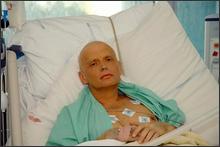
Alexander Litvinenko’s died from exposure to radioactive Polonium-210 in London on November 23, 2006. Even though there was too much Polonium 210 in Litvinenko’s body for the radioactive isotope to have occurred naturally, the British health authorities were unable to determine how the man-made substance "entered his body," and with typical British understatement classified it merely as a "suspicious death." The issue remains: how did Litvinenko come in such close proximity to a deadly radioactive isotope.
There are two hypotheses that could account for this fatal Polonium 210 contamination:
1) The murder hypothesis: Someone surreptitiously sprinkled particles of Polonium 210 on his food or in his drink. And Scotland Yard detectives are now proceeding on the allegation that it was murder,
2) The accident hypothesis: Polonium 210 particles escaped from a vial, envelope, or other container that he was carrying.

The media initially fastened on the murder hypothesis after it erroneously reported that Litvinenko had been given the rat poison Thallium and then speculated that the motive for the murder was to prevent him from disclosing information about criminal deeds of the Russian government. Even after it turned out (three weeks later) that the cause of death was not Thallium, but Polonium 210, the murder hypothesis continued to gain traction. Polonium 210, however, has very different attributes from Thallium as a murder weapon. For one thing, unlike Thallium which can kill over night, Polonium 210, takes weeks to kill. (Litvinenko, in fact, lived-- and talked to the media-- for three weeks.) So it is not efficient if the purpose is to silence a victim. Moreover, as the particles persists for months, it leave tell-tale trail of radioactivity, and it can even be traced back to the lab that produced it.

Police investigators traced the Polonium 210 to at least six locations that Litvinenko reportedly visited on November 1st: 1) his own home, 2) the offices of billionaire Russian exile Boris Berezovsky (his sometime employer) 3) the headquarters of business intelligence company Erinys, 4)the Itsu sushi restaurant, where he had lunch with Italian "defense consultant" Mario Scaramella 5) the Millennium hotel, where he with the two Russian businessmen, and finally, 7) the Barnet General Hospital where he was admitted that evening. Two other people also got contaminated with Polonium 210-- Litvinenko's wife Marina and his lunch partner Scaramella. The common link in this contamination patter is Litvinenko. According to the murder theory, the assassin would have had to sprinkle the Polonium onto Litvinenko's food at the earliest contaminated location and Litvinenko himself would have contaminated the subsequent locations with low-level traces of Polonium 210 that oozed out of his body. The problem here is that Scaramella got contaminated at Itsu Sushi-- the only place he met with Litvinenko before he was hospitalized-- which, according to medical experts, could have only came from his exposure to a primary source (and not Litvinenko's secondary oozings), yet the strength of the Polonium 210 at the Millennium Hotel, which Litvinenko visited before going to the Itsu Sushi, reportedly was too strong to have come from Litvinenko's excretions (Daily UK Telegraph December 1,2006). If so, the Polonium 210 container--presumably a vial or envelope-- was present at two of the locations that Litvinenko visited. Since Litvinenko was at both locations, and Scaramella was not, he would be carrier of the container of Polonium 210. In addition, the date that the headquarters of Erinys may have been well before the contamination of the Sushi bar and the hotel. According to Andrei Lugovoi, the ex-KGB associate whom he met with at the Millennium Hotel, "Alexander Litvinenko, my business partner Dmitry Kovtun and I were in London on October 17 at a meeting in the office of (private security company) Erinys." Since traces of Polonium 210 cannot be precisely dated, the contamination of those offices could have occurred two weeks before Litvinenko was poisoned. If so, either Litvinenko or his associates in this unknown business had a container of Polonium 210 in mid-October.

The accident hypothesis , which also has problems, would explain the radiation from a primary source being found at two locations, as well as the radiation traces that predated Litvinenko's poisoning at the Eryns offices and the British Airlines plane. In this alternative theory, the radiation came from a vial of smuggled Polonium 210, which suffered undetectable damage or some spillage from transferring it from one vial to another. The leakage onto Litvinenko's clothing may have occurred as early as October (accounting for the undated traces in offices and planes). Then, according to the accident hypothesis, some particles would have been ingested by Litvinenko, his wife Marina, and Scaramella. Why would Litvinenko or his associates have a sample of Polonium 210?
The answer is thar Polonium 210 is a valuable commodity in any sizable quantity. Among its more nefarious uses, it can be used to control a chain-reaction in an early-stage clandestine nuclear weapons programs. Iraq, for example, in 1990 had investigated using polonium 210, as an initiator for a crude U-235 bomb. ( Polonium 210 traces were also found by IAEA inspectors on Iranian nuclear components in 2000. ). It may be relevant here that Mario Scaramella told authorities that Litvinenko’s past interests had included the "smuggling of nuclear material out of Russia." (In 1999, he was jailed for eight months in Lefortovo Prison in Moscow before the charges were dropped.) He might have a host of reasons for possessing a sample of Polonium 210, ranging from establishing the bona fides of someone claiming to have access to a Russian nuclear facility to investigating the traffic in components for nukes. He (or his associates) might also be acting as an intermediary in its sale.

At this stage, either hypothesis is possible. Why rush to judgment before the results of the inquest?

Tuesday, August 15, 2006

Puffing Up The 911 Commission


In July 2004, the National Commission on Terrorist Attacks Upon the United States, popularly known as the 9/11 Commission, published its final report. Coming in the midst of the presidential campaign, it won the quick endorsement of both candidates and wide acceptance in the media. In "Without Precedent," the commission's co-chairmen, Thomas Kean and Lee Hamilton, offer an inside account of their investigation of the 9/11 tragedy.
The book's title is somewhat of a misnomer. There were of course dozens of precedents for high-level bipartisan inquiries, such as the Warren Commission's investigation of the JFK assassination. More to the point, there was a precedent for the investigation of the 9/11 attack: the Joint Inquiry by the House Permanent Select Committee on Intelligence and the Senate Select Committee on Intelligence. Indeed, the 9/11 Commission was required to use the Joint Inquiry's report as its starting point and to limit itself to fill in what that report had not already covered.

The most notable difference between these two investigations was their public relations -- or, in Messrs. Kean and Hamilton's apt phrase, their "public face." The co-chairmen assumed that it was vital to be perceived "as having full access to the most secretive material in the government."
To build this impression, they recount in the book how they prevailed in their battle for information with a secretive Bush administration, an evasive military bureaucracy and recalcitrant New York City officials. They also had to cultivate the media. So both chairmen appeared on the TV talk shows, gave joint press interviews and did everything possible to build an aura of openness around the investigation -- hoping to avoid, as they explained, "the kinds of conspiracy theorizing that have followed in the wake of other inquiries."

For the commission to succeed, Messrs. Kean and Hamilton had to nurture the impression that the commissioners had seen all the evidence regarding 9/11 and had independently assessed it

In reality, however, the 9/11 Commission was neither exhaustive nor independent. If the investigation had truly been as exhaustive as advertised, it would have made a genuine effort to weigh evidence that ran counter to its thesis. But it did not. Consider how the 9/11 Commission dealt with Capt. Scott Phillpott, a high-ranking naval intelligence officer who asserted that through data mining his military intelligence unit, code-named Able Danger, had identified Mohamed Atta as a potential terrorist in 2000 and even had his photograph on a chart.

Since the staff could not find any such chart in the documents that it had obtained from the Pentagon, and because Capt. Phillpott's account "failed to match up" with the staff's conclusion that Atta was unknown to U.S. intelligence prior to 9/11, this putative identification of Atta was omitted from the commission's report (and a number of commissioners were not informed about it).
Later, the Pentagon said that at least four other intelligence officers in the unit had confirmed that they had seen the photograph of Atta or recalled hearing Atta's name prior to 9/11. The Pentagon also explained one possible reason the chart with Atta's photo was missing: The military had destroyed many Able Danger records in 2001. To be sure, there were reasons to be skeptical about eye-witness accounts, but an exhaustive investigation would have at least heard them.

Nor was the 9/11 Commission able to independently evaluate or verify crucial information it received from intelligence agencies. Although the CIA had imprisoned seven al Qaeda conspirators who had planned, directed and coordinated the 9/11 attack, the agency refused to give the commission access to the prisoners. In the case of the Warren Commission, Chief Justice Earl Warren went to Jack Ruby's prison cell to personally question Oswald's killer. In the case of the 9/11 Commission, the commissioners were not allowed to speak to, see or know the whereabouts of conspirators. The commission could not even question the prisoners' CIA interrogators about the way information had been obtained from them.

The co-chairmen admit in "Without Precedent" that they "had no way of evaluating the credibility of detainee information." But apparently that did not discourage them from accepting, essentially at face value, information from the prisoners, delivered via a CIA "project manager," if it would fill in gaps in the commission's investigation.

For example, the CIA reported that one key prisoner, Ramzi Binalshibh, had said co-conspirator Atta "did not meet with anyone" when he went to Prague in June 2000 -- even though Binalshibh himself was not in Prague and had no first-hand knowledge. He further alleged that on another two journeys, Atta went to Spain solely to talk with him and met no other conspirator -- but Binalshibh was not in Spain during all of Atta's visits. And, again through the medium of the CIA project manager, Binalshibh informed commissioners that Osama bin Laden would not have allowed Atta to meet with an Iraqi intelligence officer because the al Qaeda leader was upset with Saddam Hussein's treatment of Muslims.
Even though such contributions were indeed unverifiable -- particularly the one that required Binalshibh to read bin Laden's mind -- the 9/11 Commission came to rely on this information, giving it the benefit of the doubt when conflicting information surfaced. For instance, the commission uncovered CIA documents that threatened to complicate matters by dragging Iran into the 9/11 conspiracy: The documents revealed that Iran had "apparently facilitated" the travel of most of the 9/11 "muscle hijackers" in flights from Afghanistan by not stamping their passports, and that Imad Mugniyar, the Hezbollah terrorist group's infamous chief of terrorist operations, had flown with the hijackers. But the commissioners merely referred the "troubling" matter to the CIA project manager.
At that point, the report was only one week away from publication. The project manager quickly ran the information past the agency's prisoners and sent a reply back "just in time for inclusion in the Report," Messrs. Kean and Hamilton write. Result: "We found no evidence that Iran or Hezbollah was aware of the planning for what later became the 9/11 attack." Such CIA feeds permitted the commission to hew to its theory that al Qaeda carried out 9/11 with no help from any outside party or government.
With this book, Messrs. Kean and Hamilton have shown how a government-appointed commission managed to create the appearance, if not the reality, of an exhaustive independent investigation and artfully transformed itself into a lobby for the reorganization of the intelligence establishment. Now that is without precedent.